
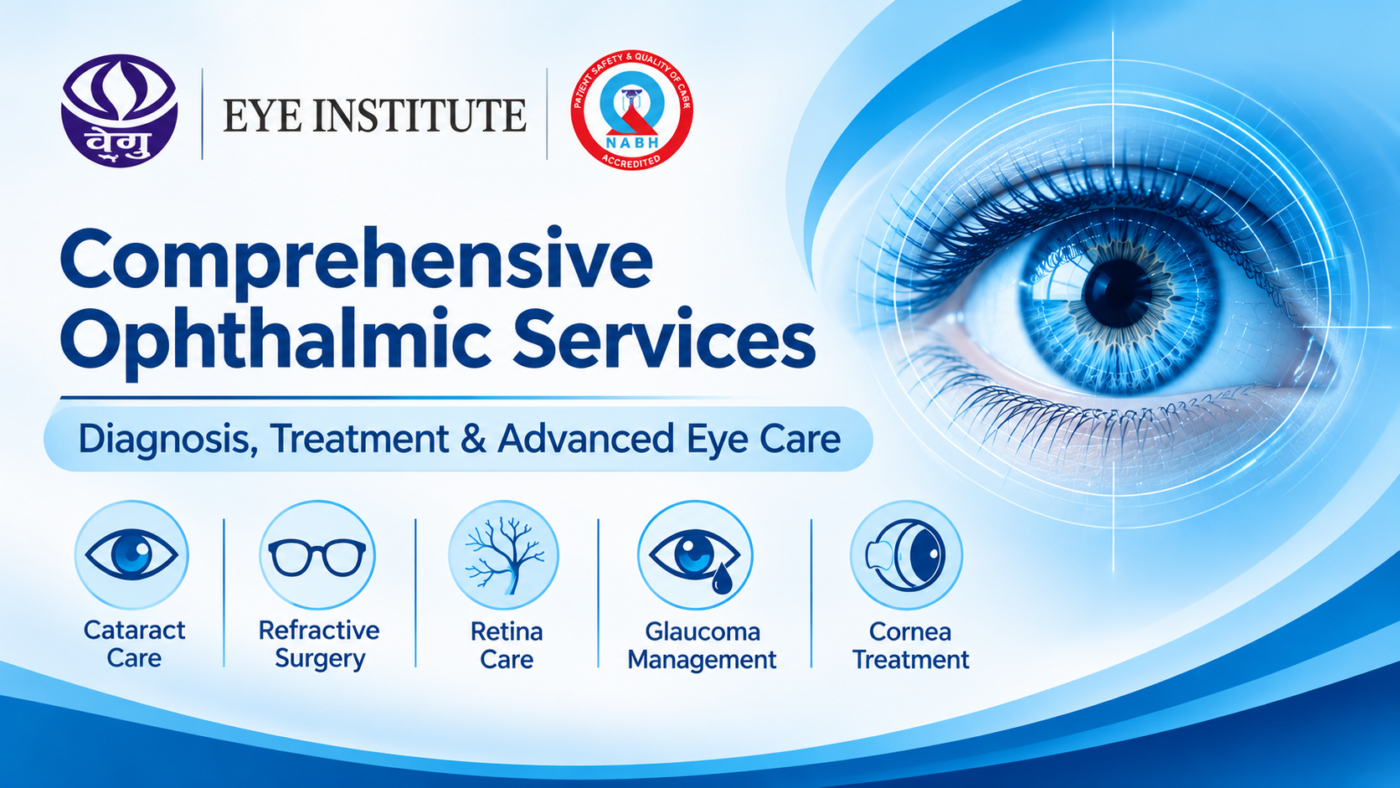
Healthy vision is essential for maintaining quality of life. Regular eye examinations, early diagnosis and appropriate medical care play an important role in preventing vision problems and managing eye conditions. Comprehensive ophthalmic services cover the diagnosis, management and treatment of various eye diseases and vision-related conditions.
Venu Eye Institute provides comprehensive eye care through its network of eye hospitals, offering specialist consultations and treatment facilities across different locations. From routine eye examinations to specialised ophthalmic procedures, the focus is on delivering accessible and quality eye care for patients of different age groups.
Comprehensive Ophthalmic Services at Venu Eye Institute
Different eye conditions require specialised evaluation and treatment. Venu Eye Institute offers eye care services across several ophthalmic specialities.
-
Cataract Surgery and Management
A cataract develops when the natural lens of the eye becomes cloudy, resulting in blurred vision, glare and difficulty seeing clearly. Cataract surgery involves removing the cloudy lens and replacing it with an artificial intraocular lens (IOL).
An ophthalmologist evaluates the cataract and recommends suitable surgical options and lens choices based on the patient’s eye condition and visual requirements.
-
Refractive Surgery and Vision Correction
Refractive errors, including myopia, hyperopia and astigmatism, can affect the clarity of vision. Refractive surgery includes procedures such as LASIK that aim to reduce dependence on spectacles or contact lenses.
A comprehensive preoperative eye examination is necessary to assess corneal health, refractive error and suitability for vision correction procedures.
-
Vitreo-Retinal Services
The retina is a light-sensitive layer located at the back of the eye that plays a vital role in vision. Retinal disorders can affect central or peripheral vision and may lead to serious complications if left untreated.
Common retinal conditions include:
- Diabetic retinopathy
- Retinal detachment
- Age-related macular degeneration
- Retinal vascular disorders
- Macular conditions
Diagnosis may involve specialised investigations such as Optical Coherence Tomography (OCT), retinal imaging and other ophthalmic examinations. Treatment options depend on the specific retinal condition and may include laser procedures, intravitreal injections or vitreoretinal surgery.
-
Glaucoma Diagnosis and Management
Glaucoma refers to a group of eye diseases that cause progressive damage to the optic nerve. It is often associated with elevated intraocular pressure and can lead to permanent vision loss if not diagnosed and managed in time.
Glaucoma evaluation may include intraocular pressure measurement, optic nerve assessment, visual field testing and other diagnostic investigations.
Depending on the type and severity of glaucoma, treatment may involve medications, laser procedures or surgical intervention.
-
Corneal Diagnosis and Treatment
The cornea is the transparent outermost layer of the eye that helps focus light. Corneal disorders, infections, injuries and degenerative conditions can affect its transparency and visual function.
Common corneal conditions include:
- Corneal infections and ulcers
- Keratoconus
- Corneal scarring
- Corneal dystrophies
- Corneal injuries
Treatment depends on the underlying condition and may include medications, specialised procedures or corneal transplantation when clinically indicated.
Importance of Early Diagnosis and Regular Eye Examinations
Many ophthalmic conditions develop gradually and may not cause noticeable symptoms during their early stages. Regular eye examinations help identify potential problems, monitor existing conditions and support timely treatment.
You should consider consulting an ophthalmologist if you experience:
- Blurred or fluctuating vision
- Persistent eye pain or redness
- Frequent headaches or eye strain
- Difficulty seeing in low-light conditions
- Flashes of light or sudden appearance of floaters
- Sudden changes in vision
Sudden vision loss or a rapid change in eyesight requires urgent medical evaluation.
How to Choose the Right Eye Care Centre
Choosing an appropriate eye care centre is important for accurate diagnosis and effective treatment. Consider the following factors when selecting an ophthalmic facility:
- Qualified and experienced ophthalmologists
- Availability of diagnostic and imaging facilities
- Access to specialised ophthalmic departments
- Appropriate surgical and treatment facilities
- Clear patient guidance and follow-up care
- Convenient hospital locations and appointment access
A comprehensive eye care facility should provide suitable consultation and treatment guidance based on individual eye health needs.
Comprehensive Eye Care at Venu Eye Institute
Venu Eye Institute is committed to making quality eye care accessible through its network of eye hospitals. With specialised ophthalmic services, experienced eye care professionals and a focus on patient-centred care, the institute aims to address a wide range of vision-related conditions.
Patients can explore the available services and hospital locations to learn more about specialist consultations, diagnostic facilities and treatment options.
Book an Ophthalmology Consultation
Whether you require a routine eye examination or specialised evaluation for an existing eye condition, timely consultation with an ophthalmologist is an important step towards maintaining healthy vision.
Explore the ophthalmic services at Venu Eye Institute and contact the team to enquire about appointments, specialist consultations and available treatment facilities.
Prioritise your vision with comprehensive ophthalmic care at Venu Eye Institute.
Explore Our Eye Care Services | Find Our Hospital Locations
Frequently Asked Questions
- What are comprehensive ophthalmic services?
Comprehensive ophthalmic services include the examination, diagnosis, management and treatment of eye conditions. These may cover cataract, refractive errors, retinal disorders, glaucoma and corneal diseases.
- What is the difference between ophthalmology and optometry?
Ophthalmology is a medical speciality concerned with the diagnosis and treatment of eye diseases, including medical and surgical management. Optometry primarily focuses on vision testing, refractive error correction and certain aspects of primary eye care.
- Which eye conditions require specialist consultation?
Conditions such as cataracts, glaucoma, diabetic retinopathy, retinal detachment, corneal disorders and significant refractive errors may require evaluation by an ophthalmologist.
- Why are regular eye examinations important?
Regular eye examinations help detect vision changes and eye diseases at an early stage, including conditions that may not produce noticeable symptoms initially.
- When should I consult an ophthalmologist?
Consult an ophthalmologist if you experience blurred vision, persistent eye discomfort, redness, flashes of light, floaters or other changes in eyesight. Sudden vision loss requires urgent medical attention.
- Does Venu Eye Institute provide specialised eye care?
Venu Eye Institute offers ophthalmic services across various specialities. Patients can explore the services and hospital locations pages for information about available facilities and consultations.
